


You may have a Grade 70 chain with a clear working load limit, yet still be unsure whether the hooks and binder make it suitable for your load. Chain size is only one part of that decision. The fittings, anchor points, and way you secure the cargo also matter. This guide explains the main Grade 70 transport chain specifications, reference sizes, common attachments, and checks that help you buy a compatible tie-down assembly.
What Is Grade 70 Transport Chain Used For?
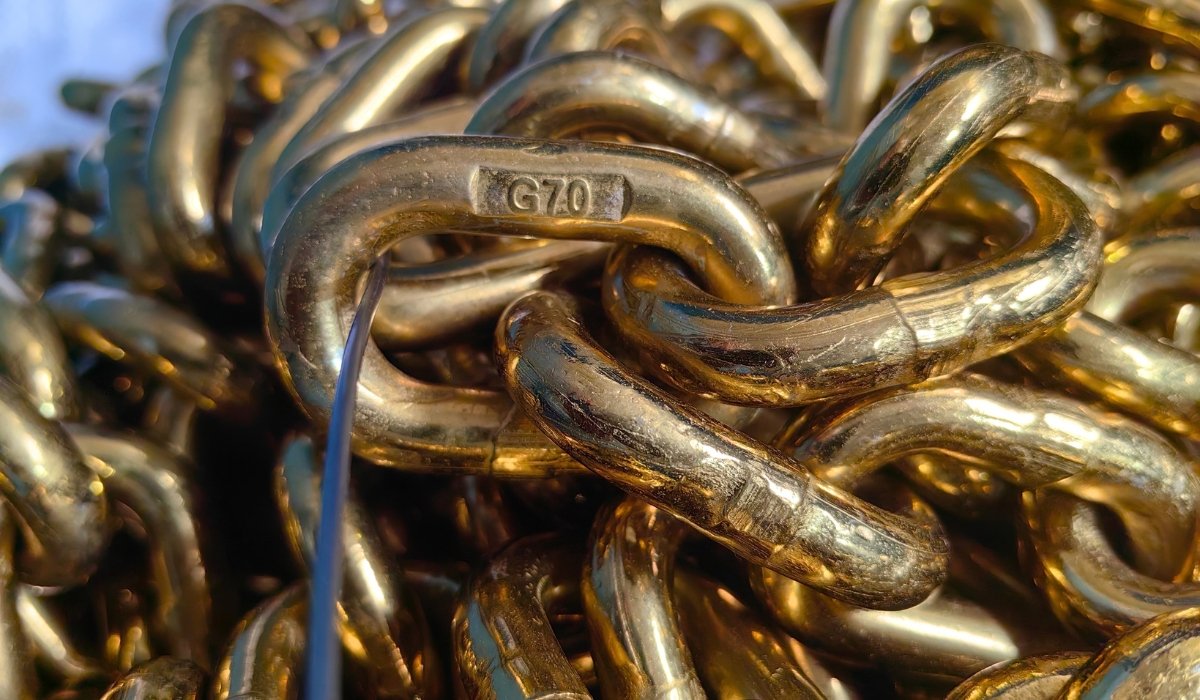
Grade 70 transport chain is a heat-treated carbon steel chain made for load binding and cargo securement. You may also see it sold as G70 transport chain, G70 chain, binder chain, or tie-down chain. These names describe its transport role, but they do not tell you the rating of every hook or binder attached to it. Yellow zinc or yellow chromate finishes are common. The finish helps protect the steel, but color alone does not confirm the chain grade.
The main limit is clear: Grade 70 transport chain is not for overhead lifting. ASTM A413/A413M includes Grade 70 in its carbon steel chain specification for load binding and other uses outside overhead lifting. A transport chain’s high breaking force or proof test does not turn it into a rated lifting chain. If your job involves lifting a suspended load, select equipment designed and rated for that task instead.

Which Specifications Should You Check?
When you compare two Grade 70 chains, start with the intended use and the applicable specification. Then check the nominal chain size, the working load limit (WLL), link dimensions, finish, markings, and the documents supplied for the exact product. A size name such as 3/8 inch identifies a nominal chain size. It does not give you every link dimension or the rating of a finished assembly.
WLL is the load rating for normal use. A proof test checks whether a chain meets a specified test requirement. Minimum breaking force is a separate strength measure. Neither test figure is permission to use the chain at that force. The NACM welded steel chain specification says its proof-test and minimum-breaking-force figures must not be used as service or design loads.
Link fit matters as well as strength. Ask for the link’s material diameter, inside length, and inside width when a hook, connector, or tensioner must fit a particular chain. A hook that looks close in size may not seat as intended. For repeat orders, confirm the agreed dimensions and tolerances on the drawing or product sheet, along with the chain grade and WLL.
Grade 70 Chain Sizes and Reference WLLs
The table below gives the nominal sizes and maximum WLL values in NACM’s 2010 Grade 70 transport chain table. These are standard reference figures, not a rating or test result for a particular Tuohai Hardware batch. Confirm the actual chain and assembly ratings in the supplier’s current product documents before use.
| Nominal chain size | Nominal metric size | NACM reference WLL |
|---|---|---|
| 1/4 in | 7.0 mm | 3,150 lb / 1,430 kg |
| 5/16 in | 8.7 mm | 4,700 lb / 2,130 kg |
| 3/8 in | 10.0 mm | 6,600 lb / 2,990 kg |
| 7/16 in | 11.9 mm | 8,750 lb / 3,970 kg |
| 1/2 in | 13.0 mm | 11,300 lb / 5,130 kg |
| 5/8 in | 16.0 mm | 15,800 lb / 7,170 kg |
| 3/4 in | 20.0 mm | 24,700 lb / 11,200 kg |
Source: NACM Welded Steel Chain Specifications, Table III, adopted April 11, 2010. Its table also states that Grade 70 transport chain must not be used for overhead lifting. Sizes such as 1/4, 5/16, 3/8, and 1/2 inch appear often in transport-chain catalogs; the full standard table includes other sizes. Availability depends on the supplier and product line.
Do not use this table to choose a chain from cargo weight alone. A larger chain has a higher reference WLL, but the completed tie-down may be limited by its hook, binder, connector, or anchor point. The link’s inside dimensions can also differ between products with the same nominal size. Check the drawing and the rating of the exact assembly you plan to buy.
Which Attachments Belong With a Grade 70 Chain?
An attachment must fit the chain and have a suitable rating for its role. The options below serve different purposes; their names are not a substitute for checking the maker’s size range and WLL.
Clevis grab hooks engage chain links and are common at the ends of transport-chain assemblies. Clevis slip hooks with a latch are another end-fitting option. Before choosing either type, check the exact hook’s specified chain-size range, WLL, and fit with the connection point. A matching nominal chain size or the presence of a latch does not establish the hook’s rating.
Coupling links and double clevis links can join compatible cargo-control components. Do not assume that any connector which closes around the chain is suitable for a rated repair. Use a connector that the chain or assembly maker accepts for that purpose, with the matching grade, size, and WLL. A damaged chain should be taken out of service until the maker’s repair rules have been checked.
Load binders apply tension to the tie-down. Ratchet binders and lever binders use different mechanisms, so choose one that suits your work method and can be operated according to its instructions. First confirm its stated chain-size range and WLL. A binder marked for both 5/16 and 3/8 inch chain still needs to be checked against the rating of the chain you actually use. A higher-rated binder cannot increase a lower-rated chain’s WLL. Do not use an unapproved bar or other added leverage to tighten a binder beyond the maker’s instructions.
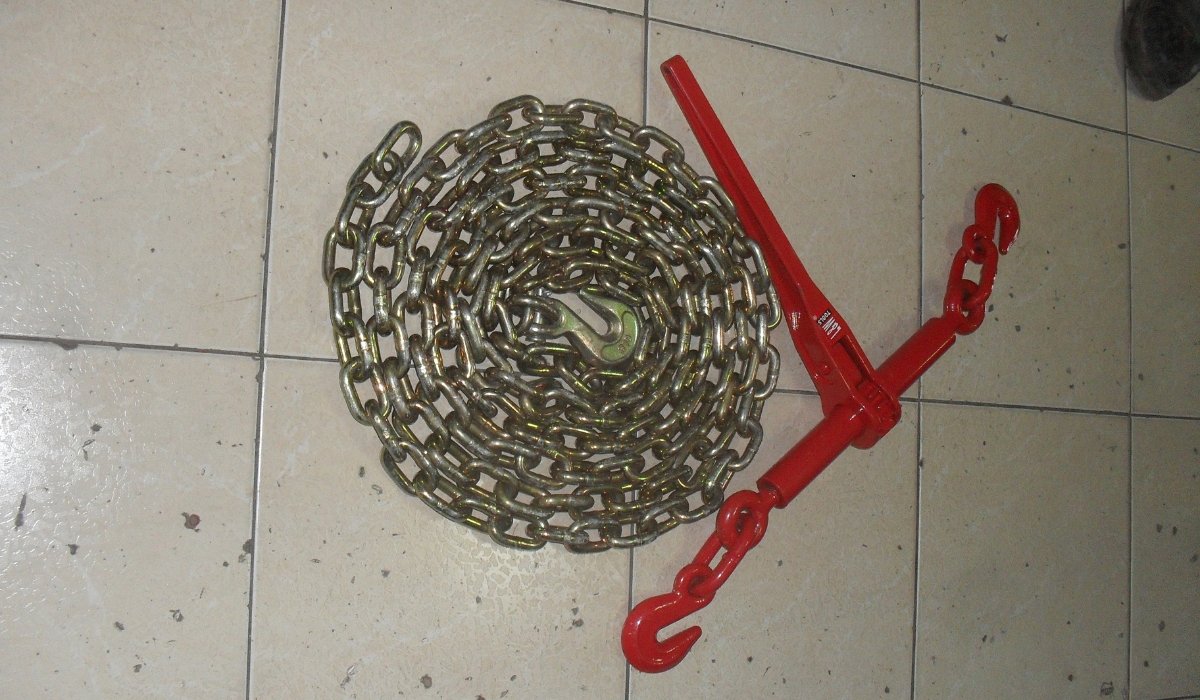
If you order a chain with hooks already fitted, ask whether the stated WLL is for the complete chain assembly. If you buy the chain, hooks, and binder separately, collect each item’s rating and check the finished setup before it is put into service. A yellow finish or a matching nominal size cannot establish compatibility by itself.
How Do You Check a Complete Tie-Down Before Use?
First identify the cargo, its weight, the available attachment points, and the transport rules on your route. Decide whether you are using direct tie-downs from vehicle to cargo or tie-downs that pass over or around it. That arrangement changes how the rated capacity is counted under U.S. rules. Heavy equipment and certain other cargo may also have specific securement requirements.
Next, check the lowest WLL in the complete system. Under U.S. 49 CFR 393.108, the tie-down rating is limited by its lowest-rated component, including the tensioner, or by the anchor point if that is lower. FMCSA’s cargo securement guidance also requires an aggregate WLL of at least half the cargo weight for the covered U.S. road transport, with different counting rules for direct and over-the-load tie-downs. The minimum number of tie-downs is a separate requirement. A chain WLL table alone cannot tell you how many chains a load needs.
Before use, inspect the chain, hooks, connectors, binder, and anchor points. Remove equipment from service if you find bent or twisted links, stretching, deep cuts, heavy wear, or damaged fittings. Check that each hook seats correctly and that the tie-down cannot loosen or release during travel. Protect contact points where edges could damage the tie-down, and follow the applicable inspection and recheck rules for the trip. FMCSA’s cargo securement rules require securement parts to be in proper working order and call for edge protection where a tie-down could be abraded or cut.
Frequently Asked Questions
What if a chain has no readable grade or WLL mark?
Do not assume it has a Grade 70 rating. For U.S. cargo securement, 49 CFR 393.108 treats welded steel chain whose grade or WLL cannot be identified as Grade 30 for WLL purposes. Ask the supplier for traceable identification and product data before assigning a higher rating. Rules in other markets may differ.
Does a direct tie-down count the same as a chain that passes over the cargo?
No. Under the FMCSA cargo securement rules, a tie-down running from a vehicle anchor point to a cargo attachment point contributes half its WLL to the aggregate WLL. A tie-down running from one vehicle anchor point over, through, or around the cargo to another vehicle anchor point contributes its full WLL. This is an aggregate-capacity calculation for covered U.S. transport, not a way to raise the rating of an individual chain. Check the minimum number of tie-downs and any cargo-specific rule separately.
Final Check Before Ordering
For Grade 70 transport chain, confirm three things in order: the chain is intended for your cargo-securement task, its size and WLL are documented for the exact product, and every hook, connector, binder, and anchor point fits and has a suitable rating. Give your supplier the required chain length, nominal size, link-fit needs, end fittings, finish, and destination market. That makes it easier to verify the assembly you will receive and avoids treating a standard reference table as a product-specific guarantee.


 English
 Russian
 Spanish
 Czech
 German